
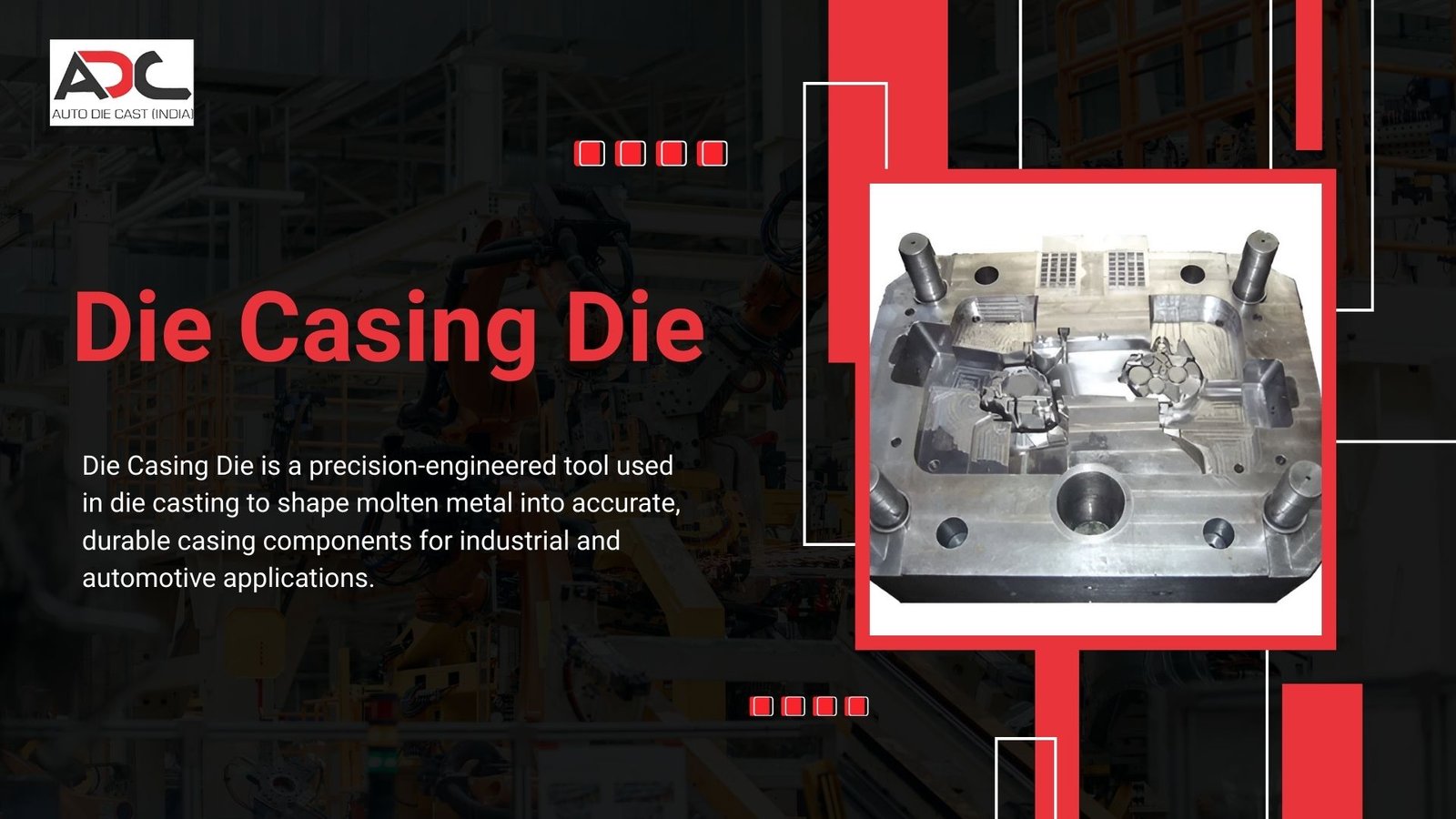
In the manufacturing industry, accuracy and consistency are critical, and this is even more important in mass production. Among the most critical factors in this process is the Die Casing Die. At Auto Die Cast (India), we have the expertise to help manufacturers select the best dies for their production processes, and this ensures that all the components produced are of the highest standards. The selection of the best die is not only dependent on the standards required but also on the efficiency of the workflow.
High-quality dies are the backbone of a successful production process. Poor-quality dies may be economical, but they can also cause defects in production, delays in production, and maintenance costs. The advantages of a good Die Casing Die are endless:
•Consistency: All products will meet the required standards.
•Strength: Dies can be reused without damaging them.
•Low Maintenance: High-quality dies require repairs and replacements at lower rates.
•Cost Savings: There are fewer defects, which in turn reduces the time and cost associated with rework.
Even the small defects in the die create some serious obstacles for the mass production. A defective die can cause problems in the production of hundreds or thousands of parts. This is why it is important to search for high-quality dies.
Selecting the right dies is not an easy task and requires many factors to be taken into consideration. The following are the factors that the manufacturers should consider:
The material used in making the die has an impact on the life of the die and its functionality. The best material to use for the Die Casing Die is high-quality tool steel. This is because it is resistant to high pressure and high temperatures, making it the best for mass production. Low-quality materials will easily bend and break when under pressure, thus producing defective products.
Design precision is of great importance. The dies should be designed with equal wall thickness, accurate venting, and measurement. A die that is well-designed will ensure proper metal flow, thus producing defect-free products and facilitating mass production.
A die that has a smooth and polished surface will aid in reducing friction when casting. A die with a rough surface will produce defects in the final product. The analysis of the surface finish of a die is a simple yet effective way of analyzing the quality of the die.
Appropriate heat treatment can also enhance the hardness and toughness of the die. A die with appropriate hardness properties can resist wear and tear, as well as have a slight degree of flexibility to resist the effects of repeated casting processes. It is always important to check the heat treatment properties and hardness requirements of the dies to be selected.
It is important to select high-quality dies that are easy to maintain. Dies that are easy to clean, lubricate, and adjust without requiring much downtime are always preferable. Dies that require constant maintenance can reduce the efficiency of mass production.
Identification of better dies before applying them to your production system could aid in preventing problems from arising in the future. Some of the factors that could be evaluated include:
•Consistency in Production: The die has the capability of producing consistent parts over a series of production runs.
•Minimal Wear: The die has a minimal amount of wear and tear with surfaces and edges still retaining their original shape despite considerable use.
•Accurate Tolerances: The parts fit together perfectly without needing a lot of adjustments.
•Reliable Supplier Documentation: Certifications, design specifications, and maintenance instructions point to a reputable supplier.
These indicators can help manufacturers ensure that they are purchasing dies that will improve their production efficiency instead of creating problems.
Although the dies are the ones that form the component, Die Casing Moulds play a very important role. They ensure that the component has structural integrity during the casting process and that the flow of the melted material is even. The use of high-quality moulds and dies ensures that the components cool evenly and are more durable.
Even with the selection of a high-quality die, inspection and testing must be done before embarking on full-scale production. The following are factors that must be considered:
1. Dimensional Verification: High precision measuring equipment must be used to ensure that all dimensions of the die are within specifications.
2. Surface Inspection: Inspection of the die should be done for cracks, pits, or surface finishes that may impact the quality of the components.
3. Trial Production Run: This is a small production run that will help in determining any potential problems and ensure that the die functions well in a real-world environment.
4. Stress and Thermal Testing: The die should be tested for its performance under operating temperatures and pressures. These measures will help ensure that your dies operate correctly in a mass production environment.
It is essential to handle and maintain the dies to extend their lifespan. The following should be followed by the manufacturer:
•Clean the dies regularly to remove any residue metal and to avoid corrosion.
•Use the necessary lubricants and anti-corrosion materials.
•The proper tools for Aluminium Die Casting should be used during the production process.
•Regular checks should be conducted to determine if there are signs of wear or minute cracks.
•The dies should be stored in a dry and temperature-regulated area to avoid corrosion and deformation.
By following the above, you will ensure that your Die Casing Die works at its best.
It is always a great relief to have a good supplier. When searching for suppliers of dies, you might consider the following:
•They have quality certifications.
•They provide product details and maintenance information.
•They have experience in mass production.
•They can assist with custom dies in case your components have special requirements.
Auto Die Cast (India) uses our knowledge in the industry along with traditional methods to produce products that will satisfy the requirements of our customers through our links with reliable Die Casing Die Manufacturers who produce quality products for mass production.
The choice of quality dies is not only a technical process but also a strategic one. The type of material, design, quality surface finish, heat treatment, and suppliers all have a major impact on the success of efficient and cost-effective mass production. The use of quality dies along with appropriate Aluminium die casting tools and adequate mould support ensures a low defect rate and high productivity. At Auto Die Cast (India), our quality and knowledge in the industry enable us to supply manufacturers with solutions that will last for a long time.
The correct die selection depends on the material quality and design precision and surface finish and die heat treatment requirements. high-quality dies can sustain a number of cycles, ensuring that the components produced are of good quality, hence appropriate for mass production.
Yes. Low-quality dies may result in warping, defective production, high scrap rates, and frequent maintenance. Spending money on high-quality Die Casing Die will ensure easy functionality, less defect, and higher productivity.
A smooth surface will aid in reducing friction and ensuring smooth flow of the molten metal. A rough surface will generate defects in the metal and will require post-processing. This will be inefficient and will generate increased costs.
The automotive industry and the electronics industry and the appliances industry and the machinery industry use Die Casing Die to produce lightweight strong metal casings.
The maintenance process for casting dies and mould tools exists to extend their operational lifespan by their ability to prevent equipment degradation while preserving surface integrity and maintaining precise measurements. The mould tools undergo protection against defects through cleaning and lubricating and repairing and inspecting procedures which extend their operational life.
Get the best Die Casing Die from Auto Die Cast (India) today and optimize your production for maximum efficiency and accuracy
Copyright © 2026 Auto Die Cast (India)
